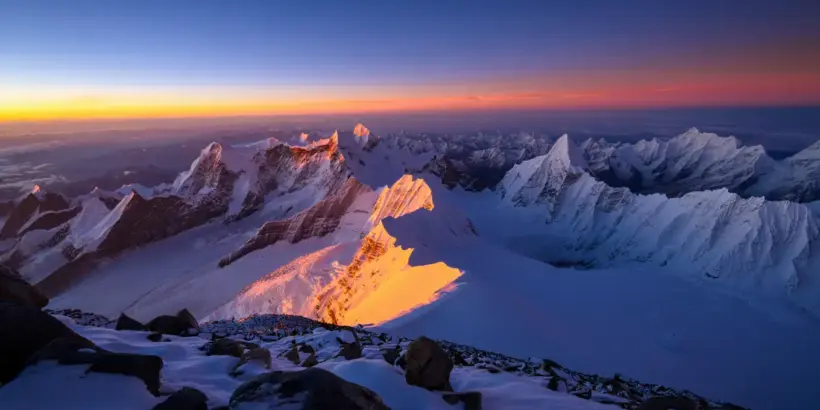
Expedition Leader: Gary Guller
Organization: Coalition of Texans with Disabilities (CTD)
Objective: Mt. Everest Summit & Base Camp Trek
Summit Date: May 23, 2003
Route: Southeast Ridge (Nepal Side)
Historical Context: The 2003 Season
The spring of 2003 was unlike any other season in the history of the Himalayas. It marked the Golden Jubilee—the 50th anniversary of the first successful ascent by Tenzing Norgay and Sir Edmund Hillary on May 29, 1953. Consequently, the Khumbu Valley was flooded with media, dignitaries, and an unusually high concentration of expeditions and media presence (CBS News / Associated Press, 2003). The atmosphere at Base Camp was chaotic, a temporary city straining under the weight of history and celebration.
Below is a video interview featuring Gary Guller discussing his historic climb and the motivations that drove him — providing personal testimony to the expedition’s mission and impact.
Yet, within this cacophony, one expedition operated with a mandate that extended far beyond the summit. Team Everest ’03, organized by the Coalition of Texans with Disabilities (CTD), arrived in Nepal not simply to climb, but to execute a complex advocacy campaign. Their presence was a direct challenge to the prevailing medical and societal models of disability.
As Expedition Leader Gary Guller stated:
“The right to explore is a right of all individuals, regardless of their ability or their disability. We as members of today’s society cannot determine the potential of any person, on the basis of their color, culture, gender, orientation or disability.” (Gary Guller, 2025, Our Interview with Gary Guller)
The mission parameters were twofold and ambitious. First, to engineer the logistics required to bring the largest cross-disability team in history to Everest Base Camp (Baylor Magazine, 2003). Second, to support the summit bid of Guller, aiming to establish the record for the first single-arm amputee to stand on the roof of the world.
This document serves as the retrospective operational log of that season, detailing the logistical engineering, the physiological adaptations, and the climbing specifications of the ascent.
Pre-Deployment and Logistics
The logistical footprint of Team Everest ’03 dwarfed that of standard commercial outfits. Planning began two years prior, necessitated by the complex interplay between U.S.-based organizers and Kathmandu-based logistics providers.
Dennis Borel, Executive Director of CTD, later recalled the scale of the undertaking by quoting architect Daniel Burnham: “Make no little plans; they have no magic to stir men’s blood.”
The Geographical Strategy: Why Nepal?
The team faced a critical strategic choice: the North Ridge (Tibet/China) or the Southeast Ridge (Nepal).
The Tibet Option: Offered the ability to drive vehicles almost directly to Base Camp. While logistically simpler for equipment transport, this posed a lethal risk for the team: rapid ascent via vehicle denies the body the necessary time to acclimatize, drastically increasing the risk of High Altitude Pulmonary Edema (HAPE).
The Nepal Option: Selected by Guller. It required a grueling multi-week trek from Lukla. However, this slow, forced march allowed for gradual physiological adaptation. Furthermore, the South Side offered established helicopter evacuation protocols from the lower valley—a non-negotiable safety requirement for a team with high medical risks.
The Team Structure
The expedition was bifurcated into two operational tiers:
- The Base Camp Team: A diverse unit including individuals with paraplegia, quadriplegia, cerebral palsy, and profound deafness. Their objective was the 5,364-meter marker of Base Camp.
- The Summit Team: An elite, lightweight climbing unit led by Guller and supported by a Sherpa climbing team, tasked with the technical ascent of the mountain.
Phase I: The Trek (Lukla to Base Camp)
The trek from Lukla (2,860m) to Base Camp is often romanticized as a “walk.” In reality, it is a jagged ascent over crumbling stone stairs, suspension bridges swaying over the Dudh Kosi River, and glacial moraine. For the CTD team, the terrain was a hostile adversary.
Engineering Access: Manual Transport
Standard wheelchairs are functionally useless in the upper Khumbu. The rocks are too large, and the trails too narrow. To solve this, the expedition relied on a human-powered logistical chain.
According to expedition archives, the team utilized a combination of trekking poles for those with limited mobility and traditional Nepalese solutions for those unable to walk. This included the use of doko baskets—woven bamboo carriers traditionally used by porters to carry heavy loads. In a remarkable display of endurance, Sherpa porters carried team members with paraplegia on their backs using these baskets, navigating steep switchbacks and suspension bridges (Baylor Magazine, 2003).
Kim, a trekking team member with hip dysplasia, articulated the group’s motivation best:
“I want to go for every child told they were too uncoordinated to dance… for every child told they cannot be part of a team because they do things differently.”
The Medical Protocol
The ascent profile was conservative. Acute Mountain Sickness (AMS) does not discriminate based on disability. The team adhered to a strict “climb high, sleep low” protocol, with extended rest days in Namche (3,440m) and Dingboche (4,410m).
The arrival at Base Camp in mid-April was a seminal moment. The team rolled into camp, effectively shattering the glass ceiling of high-altitude trekking. They had proven that the primary barrier to the Himalayas was not the terrain itself, but the logistical imagination required to navigate it.
Phase II: The Climb (Technical Operations)
With the trekking team safely descending, the operational focus shifted to the upper mountain. The objective: the summit via the South Col.
Profile of the Leader: Gary Guller
Gary Guller’s ascent is a case study in adaptive biomechanics. Having lost his left arm in a mountaineering accident in 1986, Guller had to rewrite the manual on climbing technique.
The “No Prosthetic” Decision
Operational accounts and retrospective interviews indicate that Guller climbed without a prosthetic device. While counter-intuitive to the layperson, this decision was pragmatic for the death zone. Prosthetics can restrict blood flow, increase frostbite risk, and add non-functional weight at extreme altitude. Guller adapted his technique to manipulate ropes and carabiners with his remaining hand, teeth, and core strength.
The Khumbu Icefall and Upper Camps
The route required traversing the Khumbu Icefall, a moving river of glacial ice.
Standard safety doctrine dictates “three points of contact” on the aluminum ladders bridging crevasses. Guller had to cross relying on extreme balance and core strength.
Camp IV (The Death Zone): The team established their final camp at the South Col (approximately 7,900m). At this altitude, the body effectively begins to shut down. Digestion halts, and sleep is minimal. The team utilized POISK oxygen systems, a widely used high-altitude oxygen system of the era.
The Summit Log: May 22–23, 2003
By late May, the jet stream—the high-altitude wind that usually scours the summit—shifted north, creating a narrow weather window.
The Launch
Expedition logs indicate the team departed Camp IV late on the night of May 22. Climbing at night is essential to reach the summit by morning and descend before afternoon convection storms hit. The route ascends the Triangular Face, a steep snow slope leading to the Balcony.
The Ridge and The Step
From the Balcony, the route follows the exposed Southeast Ridge.
The Hillary Step: In 2003, this legendary feature was still intact. It was a formidable vertical rock and ice face and the technical crux of the route. Guller navigated the rock using adaptive techniques, leveraging his legs to bridge the gap and resting by wrapping his arm around the fixed lines.
Reflecting on this moment of extreme exhaustion, Guller later noted, “I gave myself the permission to succeed.”
The Summit Record
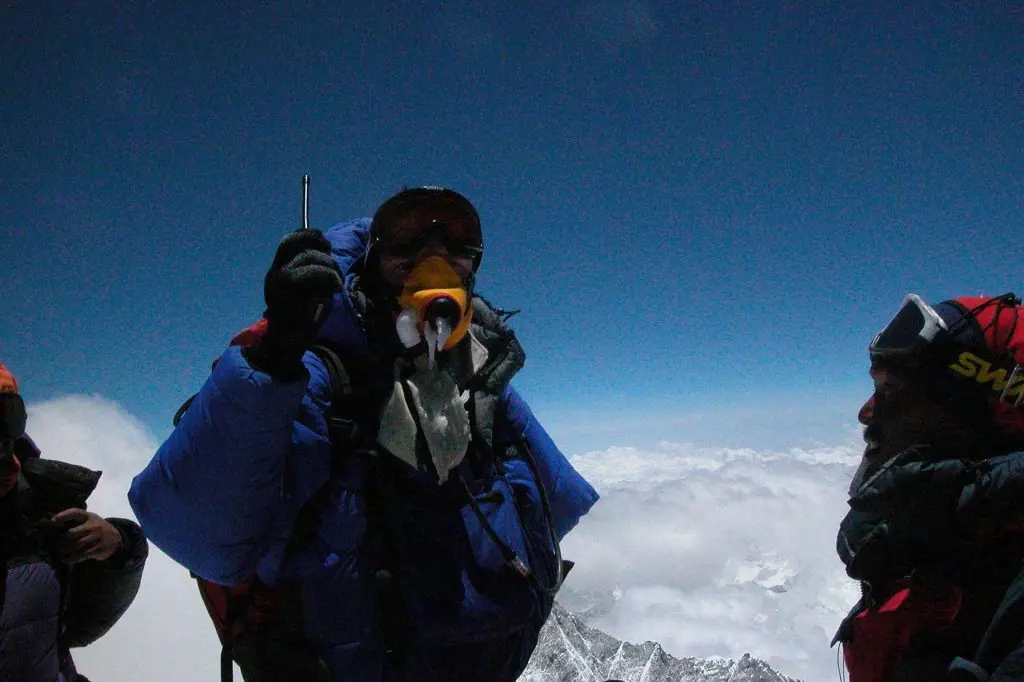
On the morning of May 23, 2003, Gary Guller reached the summit plateau of Mount Everest (8,848 meters).
He was supported by an experienced Sherpa climbing team. On the summit, Guller unfurled the banner of the Coalition of Texans with Disabilities. Communications were established via radio to Base Camp, and the news was relayed via satellite phone to Texas.
The record was official: the first person with a single-arm amputation to summit Mount Everest (Guinness World Records).
Historical Legacy
The Team Everest ’03 expedition occupies a unique space in the archives of Himalayan mountaineering.
Proof of Capability: It moved the conversation about disability in the outdoors from “participation” to “elite performance.”
The Technological Shift: The expedition was an early adopter of cyber-mountaineering, using satellite communication and online dispatch archives to document progress in near real time (MountainZone, 2003; Coalition of Texans with Disabilities, 2017).
Precedent: The logistics developed for the trekking team—specifically the use of manual transport such as doko baskets for accessibility—became a case study for future adaptive expeditions.
Expedition Data Summary
| Category | Data |
|---|---|
| Official Name | Team Everest ’03 |
| Dates of Operation | April – May 2003 |
| Permit | Issued by Nepal Ministry of Tourism |
| Region | Sagarmatha Zone, Khumbu |
| Expedition Leader | Gary Guller (USA) |
| Summit Date | May 23, 2003 |
| Sherpa Support | High-altitude Sherpa climbing team |
| Oxygen System | POISK |
| Elevation Note | 8,850m (commonly cited in 2003); 8,848.86m (Nepal–China Joint Survey, 2020) |
| Record Established | First single-arm amputee to summit Mount Everest |
Bibliography & Verified Sources
- Baylor University. On Top of the World. Baylor Magazine, August 8, 2003.
- Guinness World Records. First single-arm amputee to climb Mount Everest.
- CBS News / Associated Press. Everest Base Camp and 50th Anniversary Coverage. May 2003.
- MountainZone.com. Everest 2003 Cybercast Archive.
- Coalition of Texans with Disabilities (CTD). Team Everest Anniversary Post #6: Documenting the Trip and Reflections. 2017.
- Different & Able. Our Interview with Gary Guller. 2025.
- The Himalayan Database. Spring 2003 Expedition Records.